
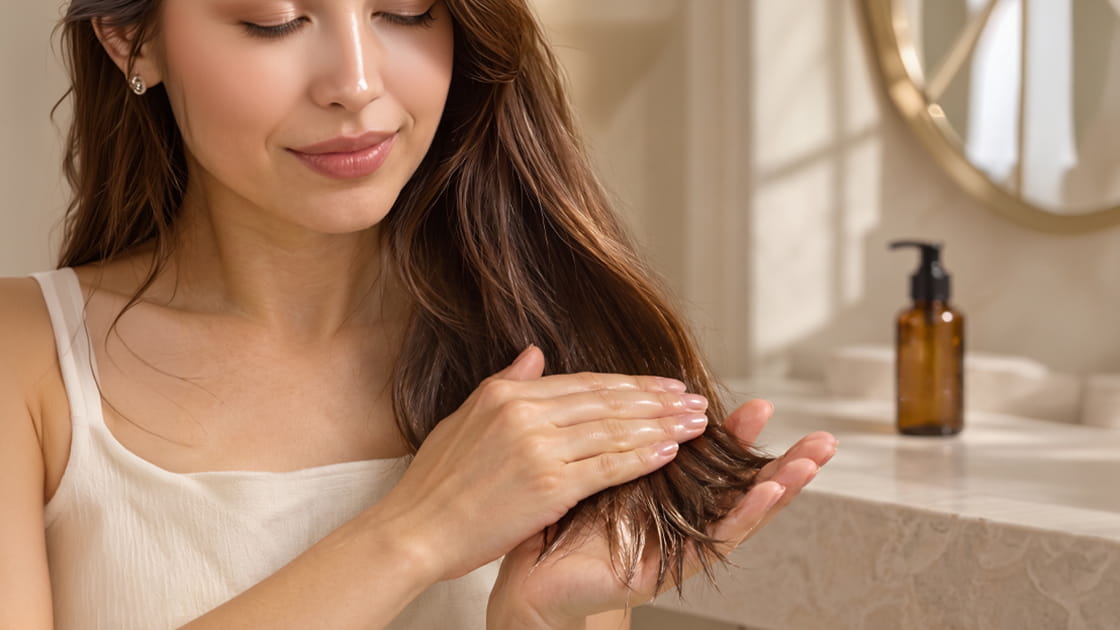
The area where the hair care oil should be applied, the hair’s moisture level, and whether rinsing is required depend on the specific type of product you are using. First, check the instructions on the packaging; then, adjust the amount carefully based on your hair’s length, strand thickness, and density. It is not correct to apply a leave-in hair care oil in the same way as a product used before shampooing.
The use of hair care oil does not rely on a fixed number of drops or a specific waiting time that applies to all hair types. The goal is to distribute the product through your hair according to the instructions. Cosmetic effects such as softness and shine do not mean that the hair strand has been permanently repaired.
How Can You Tell the Difference Between Rinse-Out and Leave-In Hair Care Oils?
To understand how a product should be used, don’t just look at its name or consistency. Check the application instructions on the packaging to see whether the product is meant to be left in the hair or rinsed out after a specific application. Phrases such as “pre-wash,” “rinse,” or “no-rinse” will help you make this distinction. The presence of the word “oil” in a product’s name does not necessarily mean the formula consists solely of pure oils.
When choosing among hair care oils, be sure to follow each product’s specific instructions. Do not treat leave-in products the same way as those that are applied before shampooing and are meant to be rinsed out. If the usage instructions are not clear enough, clarify the information provided by the manufacturer for that specific product rather than deciding on your own how long to leave it on or whether to rinse it out.
Application Area and Hair Moisture Level
When selecting the application area, keep in mind that the hair shaft and the scalp are distinct areas. Do not assume that a product intended for the mid-lengths and ends can also be used at the roots. Parting your hair according to the area indicated on the packaging allows you to apply the product more precisely to the targeted areas. Especially with thick hair, a product applied only to the outer surface may not reach the inner sections evenly.
The moisture level of your hair also affects how the product should be used. Some formulas are suitable for use on damp hair, some on dry hair, and others may be suitable for both. Do not assume these options apply to all hair care oils. If the instructions specify hair that has been towel-dried, do not treat dripping-wet hair as the same; gently remove excess water before application.
Where Should You Apply Hair Oil?
For products labeled for use on the lengths and ends of the hair, limit application to these areas. Rubbing the oil between your palms and distributing it over the relevant sections of your hair can help prevent it from accumulating in one spot. Apply the product to the scalp only if this use is explicitly stated on the product, and follow the instructions on the packaging.
Should Hair Oil Be Applied to Damp or Dry Hair?
Make your choice based on the product’s instructions for use. Do not assume that you can use the same amount of a product intended for damp hair on dry hair. If both applications are permitted, proceed by assessing the hair’s current condition and the amount of product remaining on it; do not automatically apply more oil on top of what you’ve already applied.
How Do You Adjust the Amount for Fine, Thick, and Dense Hair?
For fine hair, check how your hair looks before increasing the amount of product you use; applying too much can cause strands to stick together and reduce volume. For thick hair, focus on distributing the product evenly over the targeted area rather than applying it heavily all at once. Strand thickness alone isn’t the only factor; hair length and existing product buildup also affect how much product is needed.
Hair density is different from strand thickness: Hair with fine strands can still be dense. Working in sections with dense hair helps you control the distribution without unnecessarily increasing the amount. If the amount is specified on the label, use that as a guide. If not specified, start with a small amount and assess the distribution and appearance; add more only to the areas that need it, in a controlled manner. Do not set a fixed number of drops or pumps for every type of hair.
Usage Time and Rinsing by Product Type
Apply a product formulated for pre-wash use at the stage specified in the instructions, and remove it using the cleaning procedure described. If a processing time is specified, follow it exactly; do not assume that leaving it on longer will yield better results. For leave-in products, follow the product’s instructions regarding hair preparation, the application process, and any subsequent steps.
You don’t have to use leave-in conditioner after every wash or every day. Decide whether to reapply it based on the current condition of your hair, any product left over from previous use, and the instructions on the packaging. There’s no set order that everyone must follow for conditioner, serum, and oil. If you’re using more than one product, follow the instructions for each one and consider the weight they add to your hair when used together.
Common Mistakes When Using Hair Oil
If your hair looks heavier or more unruly than expected after application, it doesn’t always mean you need a stronger product. The amount used, how it’s distributed, and other products already in your hair can all affect the appearance. In such a case, instead of layering on more product, reassess your application technique. A product concentrated in one spot may not yield the same result as one distributed evenly throughout the hair.
Another mistake is assuming that a product has different functions based solely on its cosmetic appearance. Just because it adds shine doesn’t mean it’s suitable for the scalp or provides protection against heat styling tools. Stick to the product’s intended use rather than applying it to areas not specified in the instructions or using it in conjunction with procedures not mentioned there. In particular, consider heat application separately from whether the oil is present in the hair.
Using Too Much Product
If you want your hair to look softer but increase the amount of product without control, it can lead to a greasy appearance and a loss of volume. Do not add more product before it has been sufficiently distributed throughout your hair. Instead of trying to balance it out with other hair care products to remove the excess, follow the appropriate cleansing step for that product when necessary.
Applying Oil That Is Not Suitable for the Scalp to the Roots
Do not use a product intended for length and ends care to massage the scalp. The suitability of a product for use on the scalp cannot be determined by its name, scent, or the fact that it contains oil. If the label does not explicitly state that the product is intended for application to the scalp, do not apply it to that area; expanding its intended use does not mean it will provide additional benefits.
Applying Heat While Relying on Unverified Oil for Heat Protection
The presence of conditioning oil in your hair does not provide automatic heat protection when using a straightener, curling iron, or hair dryer. Consider this function only if it is explicitly stated and verified for the specific product. Permission to use a product before heat styling is not the same as heat protection; follow the usage instructions for both the conditioning product and the styling tool.