
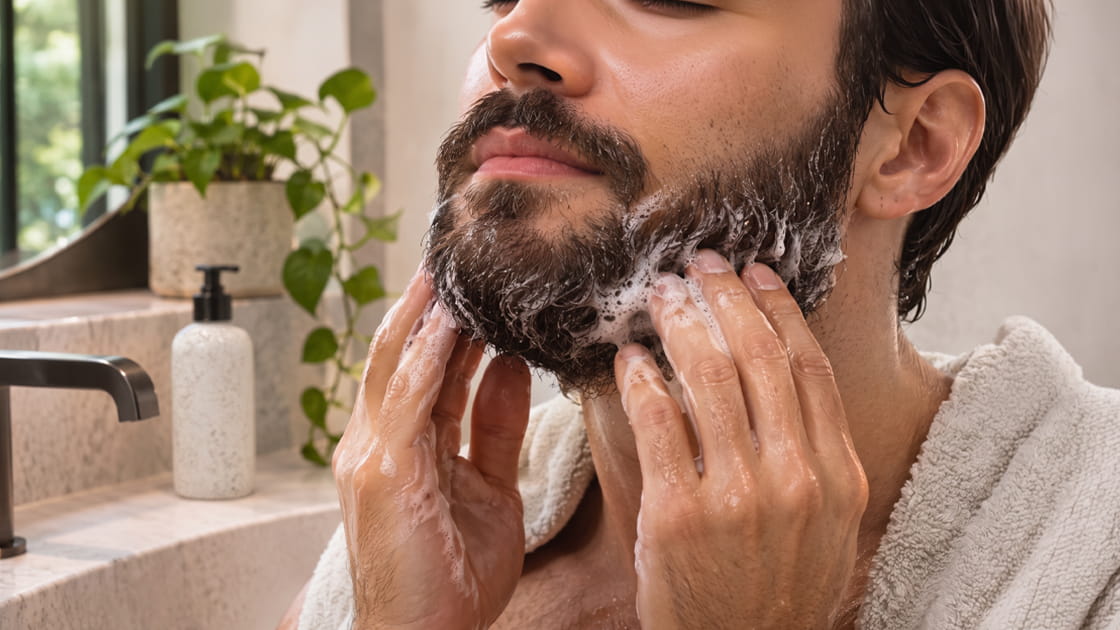
Beard shampoo is a rinse-off grooming product designed to cleanse beard hair and, depending on the product’s intended use, the skin beneath the beard. When comparing it to hair cleansers, the first thing you should check is the intended use listed on the packaging. The product’s name alone does not reveal its formula, cleansing power, or how it will feel on your skin.
You can base your choice on the length of your beard, the styling products you use, and how comfortable your beard feels after washing. You should also evaluate products labeled for both hair and beard according to the usage instructions; it’s not necessarily the case that everyone must use a separate cleanser.
How Do the Skin Under the Beard and Daily Product Buildup Affect the Choice of Cleanser?
Throughout the day, sweat, natural oils, environmental dirt, and residue from grooming products can build up on your beard. When choosing a cleanser, you should consider not only the appearance of the beard hair but also whether the product is suitable for use on the skin beneath the beard. Especially with thick or long beards, applying the product evenly and rinsing it off completely may require extra care.
To determine your daily needs, you can observe which products you use and how your beard feels after washing. If your beard looks clean but you still feel residue at the roots, you may need to reevaluate your application or rinsing technique. When reviewing Morfose’s beard care products, comparing them based on these specific needs provides a clearer picture than making a decision based solely on scent or packaging.
What Criteria Are Used to Compare Beard Shampoo and Hair Shampoo?
The difference between beard shampoo and hair shampoo cannot be explained by a single set of ingredients that applies to all products. Products may be marketed for different uses and expectations; however, the category name does not guarantee a specific pH level, ingredient profile, or suitability for sensitive skin. You should base your comparison on the information provided on the packaging and your own experience using the products.
During your review, you can look at where the product can be used, how it is applied and rinsed off, and how it feels after washing. It is incorrect to assume that a product labeled for hair can also be used on the face. Similarly, rather than assuming that all hair cleansers are drying or harmful, you should evaluate each product’s intended use separately.
Intended Use as Specified in the Formula and on the Label
The list of ingredients will help you evaluate the product; however, the presence or absence of a single ingredient does not fully determine whether the product is right for you. First, check the packaging to see if it specifies whether the product is intended for use on the beard, face, hair, or multiple areas. Do not infer the pH value or testing information from the product name alone.
Post-Cleaning Sensation and Rinsing
After washing, you can assess whether you notice any residue at the base of your beard, noticeable tightness on your skin, or an unusual stiffness in your beard hair. These observations alone do not provide a definitive conclusion about the formula; the amount used and the rinsing method can also affect the experience. Abundant lather or a strong scent are not the only indicators of suitability.
How to Evaluate Your Needs and Label Information When Choosing a Beard Shampoo?
You can start by determining what you expect from the product. Removing daily dirt, cleansing away residue from styling products, or finding an option that rinses out easily for long beards are all different priorities. Consider the length and thickness of your beard, along with your past experiences with other products. Ensuring that the product’s intended use on the label aligns with your needs is the first step in making your decision.
When reviewing the product description, be sure to read the usage instructions, rinsing instructions, and warnings together. For example, when evaluating the Ossion Premium Barber Line’s beard cleanser, you can follow the instructions on the current packaging. Do not assume that a product is suitable for sensitive skin, has undergone dermatological testing, or is free of a specific ingredient unless this is explicitly stated in the online description. If you have had issues with a particular ingredient in the past, be sure to check the ingredients list separately.
Multipurpose Products Labeled for Hair and Beards
Just because a product is marketed for both hair and beards doesn’t mean it should be applied in the same amount or in the same way to each area. Check the packaging to see if there are separate instructions for each area. If shared use is clearly stated, you can assess its suitability based on those instructions and your personal experience; don’t base your decision solely on the term “multi-purpose.”
How Do You Use Beard Shampoo?
The starting point for using the product is the instructions on the packaging. Check the packaging to see whether your beard should be wet or damp, how to apply the product, and how to rinse it off. Since there isn’t a fixed amount or processing time that applies to every product, don’t directly apply the application method of another cleanser to this new product.
When cleansing, it is important to gently spread the product over the specified application area rather than leaving it only on the outer surface. There is no need to scrub vigorously or scrape with your fingernails to reach the base of the beard. Do not rush during the rinsing step; make sure no product remains, especially in dense areas. Follow the warnings on the packaging regarding usage restrictions around the eyes and what to do in case of contact.
Wetting the Beard and Controlled Application of the Product
Wet or dampen your beard as recommended in the instructions; make sure the water reaches not only the tips but also the roots. Use the product according to the specified amount. If no amount is specified, apply just enough to control the distribution rather than starting with too much product; remember that more product does not always mean better cleaning.
Rinsing According to the Gentle Cleaning and Packaging Instructions
Gently spread the product with your fingertips and avoid tugging at your beard. If the packaging does not specify a waiting time, do not set one yourself. While rinsing, run water over different areas of your beard to remove any residue. If the product comes into contact with your eyes, follow the warnings on the packaging; do not add any steps not specified in the instructions in an attempt to enhance the cleansing effect.
How Do You Determine How Often to Trim Your Beard?
There is no one-size-fits-all schedule for beard care. Your level of sweating, the environment you’re in throughout the day, whether you exercise, the styling products you use, and the texture of your beard can all affect your needs. Someone who uses a lot of product every day may have different cleaning needs than someone who uses less. Be sure to factor in the product’s recommended frequency of use when making this assessment.
When determining how often to clean, consider not only the number of days that have passed but also how comfortable you feel after cleaning. Don’t treat the usage recommendations provided for a specific product as a rule that applies to all cleaners or everyone. Washing more frequently doesn’t necessarily mean better results in every situation. If you feel like there’s residue left behind, review the amount you’re using and whether you’re rinsing thoroughly enough before increasing the frequency.
Common Mistakes in Beard Grooming
One of the most common mistakes is applying any hair cleanser to the beard without reading the product’s intended use. Conversely, assuming that every product designed for the beard will provide the same level of comfort on all skin types also complicates the selection process. Ignoring the instructions on the packaging, leaving the product on for an unspecified amount of time, or using too much product can make it harder to control the cleansing process and prolong the rinsing time.
Another common mistake is washing only the tips of your beard and overlooking product residue at the roots. Instead of scrubbing hard or trying to use more lather to feel cleaner, reassess your application and rinsing techniques. Also, don’t expect a cleanser to promote beard growth or treat skin issues. Evaluating the product based on its primary function, the information on the label, and the comfort you experience after use provides a more realistic approach.