
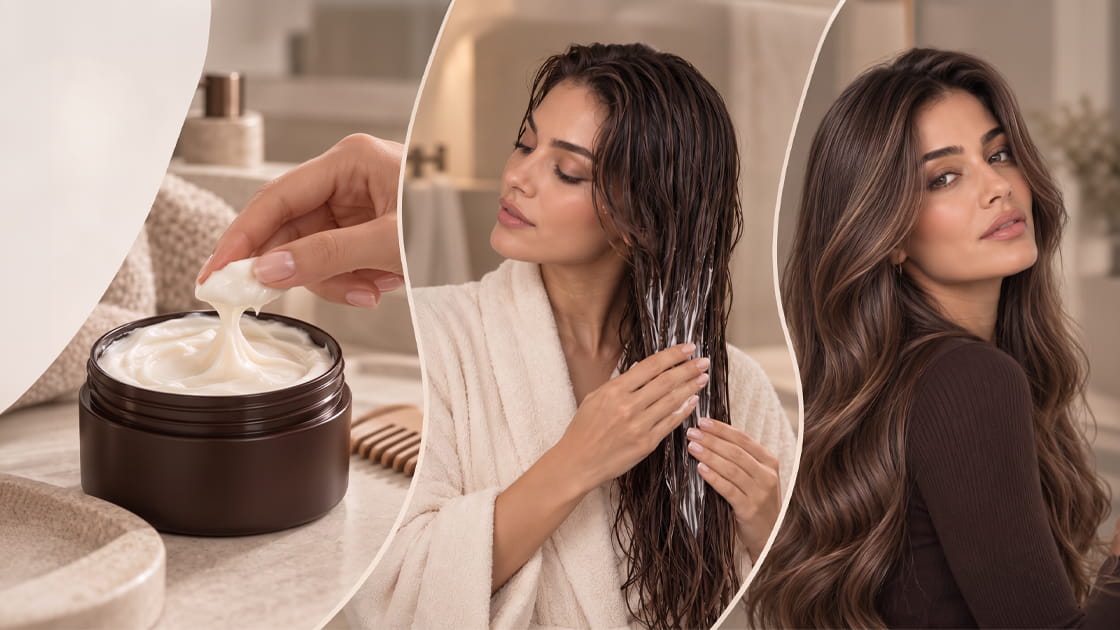
To get good results from a hair mask, simply applying a generous amount of the product is not enough. Preparing the hair for application, distributing the mask to the right areas, and rinsing it out after the recommended time must all be considered together. A rinse-out mask is typically applied to hair that has been shampooed and towel-dried. However, products used before shampooing or those that do not require rinsing may follow a different sequence; therefore, the first step is to read the usage instructions on the packaging.
The length, thickness, and care needs of your hair affect the amount you’ll use and how often you’ll apply the product. When choosing from Morfose hair masks, you can also consider how the product is used. This way, you’ll not only select a formula that suits your hair’s needs but also make it easier to incorporate the application into your daily routine.
SHOULD A HAIR MASK BE USED BEFORE OR AFTER SHAMPOOING?
Rinse-out conditioning masks are typically used after shampooing. First, cleanse your hair and scalp, then thoroughly rinse out the shampoo. Washing your hair with a shampoo suitable for your hair type helps remove oil and styling product residue before application. Next, gently squeeze out excess water from your hair and distribute the mask to the areas specified in the instructions. Rinsing your hair again after applying the mask is not a routine step unless the product specifically requires it.
Masks formulated for pre-wash treatment, however, are an exception to this order. With such a product, the mask is applied first, and the hair is washed after the specified time has elapsed. It is important to determine whether the mask you are using is a rinse-out, leave-in, or pre-wash product. Instead of adapting the instructions for different products to each other, follow the order specified on its own packaging.
SHOULD A HAIR MASK BE APPLIED TO WET OR DRY HAIR?
Standard rinse-out masks are usually applied to clean, damp hair. If water is dripping from your hair, first gently squeeze out the excess water with your hands, then blot it dry with a towel. You don’t need to rub your hair vigorously or dry it completely. This preparation allows you to distribute the mask more evenly throughout your hair; it prevents the product from washing away with the water and reduces the amount of product you use unnecessarily during application.
Applying the product to dry hair should only be done if specifically recommended in the product’s instructions. Applying every mask to dry hair does not necessarily mean it will provide more intensive care. The application instructions for pre-wash formulas may differ from those for masks used in the shower. If the packaging recommends damp hair, apply the product to hair that has been towel-dried to remove excess water; if it recommends dry hair, apply it according to those instructions.
HOW TO APPLY A HAIR MASK STEP BY STEP?
After preparing your hair as recommended by the product, divide it into several sections. Rub a small amount of the mask between your palms and apply it to the areas specified in the instructions. If you’re wondering how to apply a hair mask for the first time, working with small sections will make it easier to control the distribution. Instead of applying too much product to one area, make sure each section is sufficiently covered; be especially careful not to overlook the back sections during application.
You can gently spread the mask with your fingers, or use a wide-toothed comb if it’s suitable for your hair type. Do not pull on knots to untangle them, and do not strain the hair strands. Once the application is complete, follow the recommended processing time, then thoroughly rinse out the product. Adjusting the amount based on hair length and correctly identifying the application area are the two most important details of these steps.
HOW LONG SHOULD YOU LEAVE A HAIR MASK ON?
The amount to use depends on the length and thickness of your hair, as well as the consistency of the product. Start with a small amount for short or fine hair; for long and thick hair, gradually add enough product to coat the strands. There’s no need to create a thick layer on your hair. If the package specifies an amount, use that as a guide; keep in mind that too much product can make rinsing difficult.
SHOULD HAIR MASK BE APPLIED TO THE HAIR ROOTS?
Application to the scalp depends on the mask’s instructions for use. Do not apply a product intended for the mid-lengths and ends of the hair directly to the scalp. If application from root to tip or to the scalp is explicitly recommended, follow the specified method. Applying too much product to the roots-especially on fine hair-can make the hair look weighed down; do not apply the same rule to all masks.
HOW LONG SHOULD YOU LEAVE A HAIR MASK ON?
The processing time depends on the mask’s formula and usage instructions. There is no single time range that applies to all products. For example, the recommended time for the Morfose Milk Therapy Creamy Milk Mask is 3-5 minutes; for very dry and damaged hair, this time can be extended to 5-7 minutes. Instead of directly applying this example to another mask, use the current time specified on the packaging of the product you are using as a guide.
Leaving a hair mask on longer than recommended does not guarantee better results. In particular, leaving a rinse-out product in your hair overnight is not a good practice unless the instructions specifically recommend it. You can use a timer to keep track of the time. Also, don’t assume that a shower cap, towel, or heat treatment is necessary for every mask; follow only the method recommended by the product.
HOW DO YOU RINSE OUT A HAIR MASK, AND SHOULD YOU USE CONDITIONER AFTERWARD?
After the recommended waiting time has elapsed, rinse the mask off with lukewarm water. Gently separate strands of hair with your fingers to ensure the water reaches not only the outer surface but also the inner sections. Be especially careful not to leave any product residue at the nape of the neck and in areas with thick hair. After rinsing, there should be no noticeable layer of product left on the hair; however, you don’t need to shampoo your hair repeatedly to completely remove the feeling of softness.
Using conditioner after a hair mask isn’t mandatory every time. First, consider the care routine recommended by the product and how your hair feels after rinsing. If an additional step is needed to make combing easier, hair conditioners can be added to your routine according to the usage instructions. For fine or easily weighed-down hair, use products sparingly rather than applying two heavy-duty products in large amounts one after the other. If using a leave-in product, skip the rinsing steps.
HOW OFTEN SHOULD YOU USE A HAIR MASK?
For frequency of use, first follow the product’s recommendations. If a different frequency isn’t specified on the packaging, you can try using a rinse-out conditioning mask once a week to see how your hair responds. Using a mask with every wash isn’t necessary for all hair types. You should consider your hair’s dryness, washing habits, and other products used in your routine; don’t assume that using it more frequently will automatically lead to better results.
If your hair is easy to comb and doesn’t feel heavy after use, you can continue with the same routine. If your hair feels dull, coated, or unnecessarily heavy, first review how well you’re rinsing it out, then reassess the amount of product you’re using and how often you apply it. If your hair still feels dry, instead of immediately increasing the frequency, evaluate whether the mask you’ve chosen is suitable for your needs. Since each product may have different usage instructions, review your routine whenever you switch to a new mask.
WHAT MISTAKES SHOULD YOU AVOID WHEN USING A HAIR MASK?
One of the most common mistakes is assuming that using a larger amount will provide more effective care. Using more product than necessary can make application and rinsing more difficult. Failing to remove excess water from the hair, applying the mask only to the top sections, and applying it to the scalp without controlling the application area can also affect the results. Distributing the product evenly, using the recommended amount, and not forgetting the back sections of the hair ensures a more controlled application.
Another mistake is arbitrarily extending the processing time or leaving the rinsed-out mask on your hair. Using multiple heavy-duty products one after another after a mask can also overload your hair beyond what it needs. Instead of changing the amount, frequency, and other care steps all at once, adjust just one detail at a time. This way, you can figure out which treatment works best for your hair and maintain your care routine without adding unnecessary steps.