
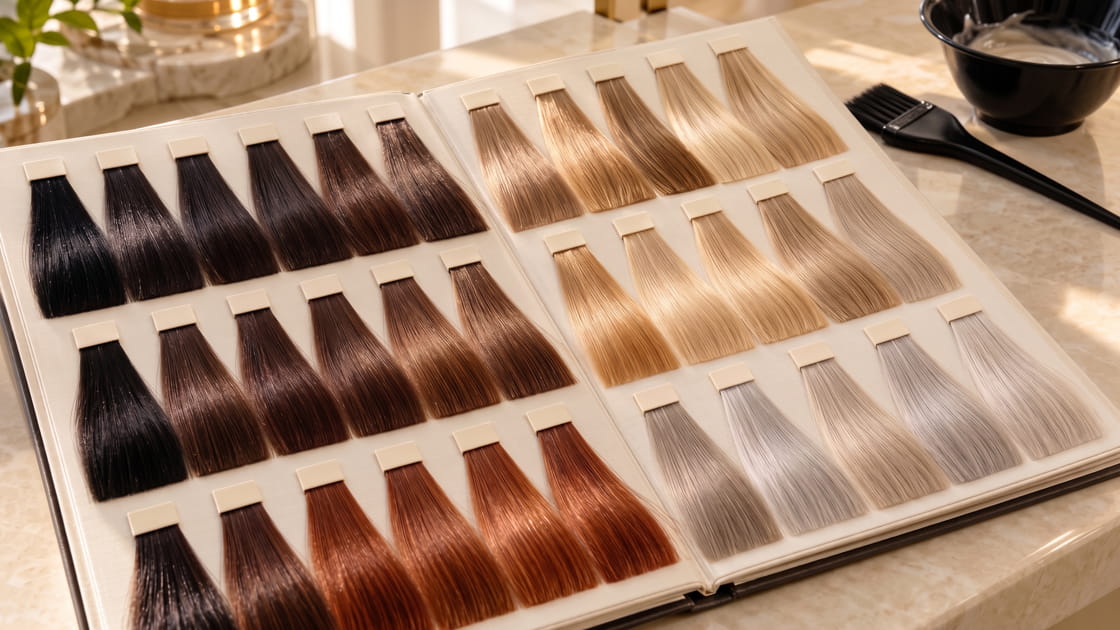
Although the color name on the dye box gives you an idea at first glance, you need to look at the numbers to distinguish between similar shades. Two colors with the same lightness level may appear warmer or cooler due to differences in reflectance. Therefore, when hair dye colors and numbers are evaluated together, it becomes easier to understand the characteristics of the selected shade and see the differences between similar options.
When reading the color chart, start with the shade’s lightness or darkness level, then examine the reflection codes, if any. This information-indicated by dots, slashes, or letters-helps identify the paint’s color family. However, understanding the codes does not guarantee that the appearance shown on the chart will be identical on every head of hair. The current hair color and previous treatments also affect the final result.
What Does the First Digit in a Hair Dye Number Mean?
The number at the beginning of a hair dye code indicates the shade’s level of lightness or darkness. In commonly used systems, lower numbers indicate darker shades, while higher numbers indicate lighter shades. For example, 1 might represent black, while 10 might represent a very light shade of yellow. You should not look only at the first digit; in two-digit codes like 10, the entire number before the separator is taken into account.
This level information is distinct from the color’s ashy, golden, or coppery character. Two hair dyes at the same level may have different reflections; nevertheless, their underlying lightness levels fall within the same group. Furthermore, a higher number does not necessarily mean the product will lighten your hair by that many shades. The code defines the target color level; determining how to achieve that level from your current hair color requires a separate assessment.
How Do You Read the Numbers After the Period or Slash in a Hair Dye Number?
The numbers following a period or slash indicate the shade of the color in many hair color lines. While the first number indicates the lightness level, the code that follows describes which color character that level has. Hair dye shade numbers help distinguish between differences-such as ash, golden, or copper-found among colors of similar lightness. Therefore, reading only the beginning of the code provides incomplete information about the color.
When there is a single digit after the separator, it generally indicates the primary reflection; when there are two digits, both the primary and secondary reflections are indicated. However, the use of zeros, repeated digits, and special series codes must be interpreted according to the manufacturer’s system. The fact that two codes-one with a dot and one with a slash-look similar does not prove that they represent the same color across different brands; the descriptions should be checked on the relevant label.
What Does the Primary Reflection Number in Hair Dye Indicate?
The primary reflection number describes the dominant tone of the color and is indicated by the first digit following the separator in most numerical systems. For example, in a series where 1 is defined as “ash” and 3 as “dore,” these numbers indicate whether a color at the same lightness level appears cooler or has a golden sheen. These correspondences should be verified against the color descriptions for the specific series being used.
What Does the Second Reflection Number on Hair Dye Indicate?
The secondary reflection number provides complementary tone information that accompanies the primary reflection. For example, in a system where 1 denotes “ash” and 3 denotes “dore,” the code 7.13 can be interpreted as a primary reflection at the 7 level with an “ash” tone and a secondary reflection with a “dore” tone. The order of the two numbers is important; 7.13 and 7.31 should not be considered the same shade. The exact designation should be verified in the manufacturer’s color chart.
How Do You Interpret Hair Dye Numbers Like 7.0, 7.1, and 7.3?
In examples 7.0, 7.1, and 7.3, the initial “7” indicates that the three colors are at the same lightness level. In a series where 0 is used for natural, 1 for ash, and 3 for dore, 7.0 is read as natural, 7.1 as ash, and 7.3 as a gold-reflective color. In this comparison, the fundamental difference lies not so much in the lightness level as in the color’s reflective character. Whether the color is named “brown” or “yellow” depends on the color chart’s nomenclature.
For example, someone looking for a cooler look can examine the color chart sample for the “ash” option, while someone who wants to see golden highlights can look at the “dore” option. However, code 7.1 does not guarantee that warm highlights will disappear completely from every hair type. Similarly, 7.3 does not produce the same golden appearance on every base color. When researching how to read hair dye numbers, it’s important to distinguish between the shade defined by the code and the actual result that will appear on the hair.
Are Hair Dye Color Codes the Same Across All Brands?
Hair dye color codes do not have exactly the same meaning across all brands. While it is common to indicate the level of lightness with a number, the numerical equivalents of shades, color names, and designations for special lines may vary. Some products use only numbers, while others combine numbers with letters. Therefore, simply applying the number you use with one brand to another brand is not a sufficient method for achieving the same look.
When making comparisons, it’s important to review not only the number but also the color name, the reflection description, and the product line. Natural tones, intense reflections, and special lightening lines, in particular, may have their own specific coding details. Keeping the packaging information from the previously used paint makes it easier to compare it with new options. This way, rather than just looking at similar numbers, you can understand which shade and sheen each product specifies on its own color chart.
How Do You Read a Hair Dye Color Chart with Numbers?
When examining a hair color chart, you should first look at the color level, then at the shade options within that same level. While the number indicates the technical distinction, the color sample helps you understand how that distinction appears. Since screen brightness, lighting in the photo, and printing conditions can alter color perception, relying solely on a digital image can be misleading. Whenever possible, the strands on the physical chart should also be evaluated under appropriate lighting.
When reviewing the options in Morfose’s hair dye category, you can use the color chart for the series you’ve chosen as a guide. For example, when using Nox Professional Cream Hair Dye, you should compare the color number with the color name and a strand sample from that series. It’s important to remember that the color chart indicates the target shade but does not determine the final result on its own. An assessment that takes into account your current hair color and treatment history allows for a more accurate interpretation of the relationship between the color number and the visual result.